6 Juli 2026
Proforest supports community-led restoration through EFI grant scheme
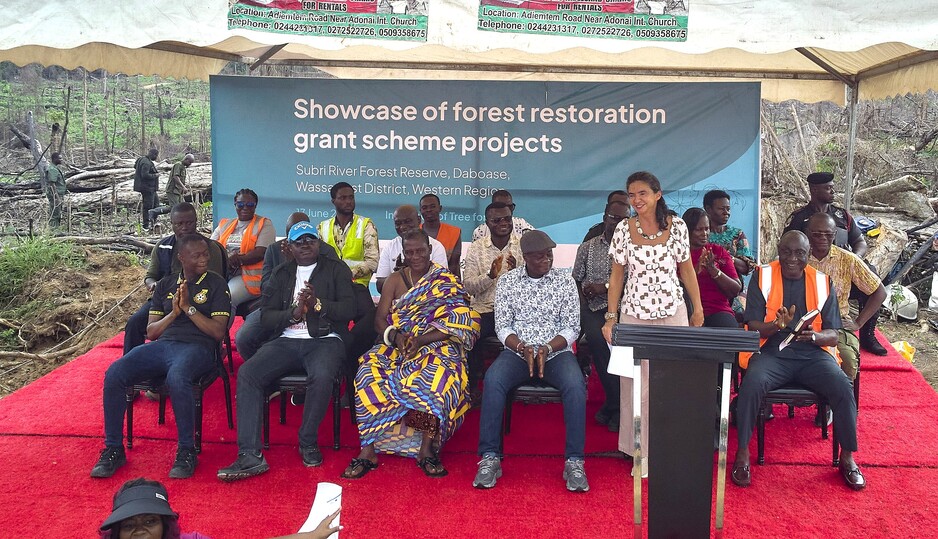
Photo Credit: EFI
Proforest is working with partners, communities, traditional leaders, and government stakeholders to restore degraded forest landscapes through the Ghana Forest Restoration Grant Scheme, a European Union-funded initiative supporting climate resilience, sustainable land use, and improved rural livelihoods.
At a recent event at the Subri River Forest Reserve, Proforest joined fellow grantees, government representatives, civil society organisations, and local communities to highlight progress toward restoring 14,000 hectares of degraded land across Ghana’s High Forest and Savanna ecological zones. Proforest is one of four organisations selected to lead restoration activities, alongside World Vision Ghana, Nature & Development Foundation, and Goshen Global Vision.
Supporting sustainable forests, cocoa landscapes, and rural livelihoods
The Ghana Forest Restoration Grant Scheme forms part of the EU Sustainable Forest and Cocoa Programme, a €6 million initiative designed to promote deforestation-free cocoa production, forest landscape restoration, sustainable land management, and climate-resilient livelihoods. Running from late 2025 through 2027, the scheme combines agroforestry, assisted natural regeneration, and community-led tree planting while building the capacity of 20,000 farmers and rural residents, with a strong focus on women and youth.
Proforest’s role in restoring the Asunafo-Asutifi landscape
Proforest’s grant focuses on restoring 8,300 hectares of degraded forest in the Asunafo North Sub Hotspot Intervention Area. The work applies dynamic agroforestry and the Modified Taungya System, a community-based tree planting model that strengthens local ownership, supports long-term tree survival, and links forest restoration with farmer livelihoods.
This work builds on Proforest’s Asunafo-Asutifi Landscape Programme, which began in 2018 and has supported collaborative action across cocoa-producing landscapes.
Why community-led restoration matters
For Proforest, effective forest restoration depends on shared responsibility. Traditional leaders, communities, civil society, government agencies, and private sector actors all have a role to play in protecting forests, restoring ecosystems, and creating resilient local economies. By combining local knowledge with landscape-level collaboration, the Ghana Forest Restoration Grant Scheme is helping to create practical pathways for sustainable production and forest protection.
Contributing to Ghana’s Tree for Life vision and global sustainability goals
The grant contributes to Ghana’s national Tree for Life ambition to restore 2 million hectares of degraded forest by 2030. It also supports wider efforts to advance responsible sourcing, deforestation-free supply chains, and readiness for emerging market requirements, including the EU Deforestation Regulation.
Proforest will work collaboratively with the European Union, the European Forest Institute, local partners, traditional authorities, communities, and all stakeholders to restore Ghana’s forests. Together, we are not only planting trees; we are strengthening partnerships, supporting sustainable livelihoods, and building a climate-resilient future for forests and the people who depend on them.