29 abril 2026
Partnerships for forest governance take centre stage in London
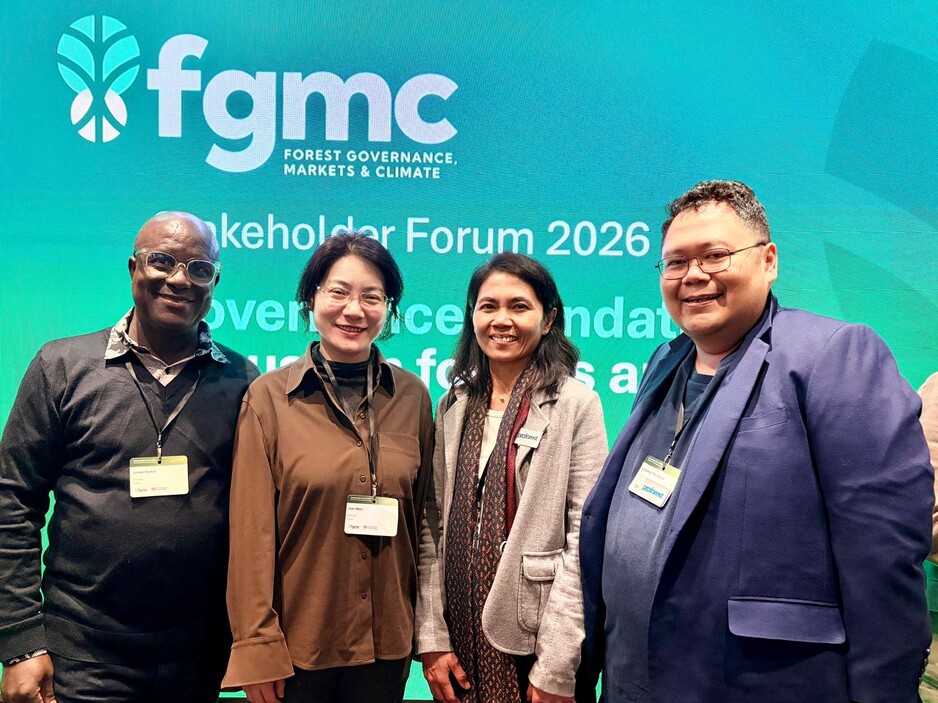
Leaders from across tropical forest countries and major consumer markets gathered in London last week for the UK Government’s Forest Governance, Markets & Climate (FGMC) Forum. At a moment when deforestation, climate risk and market regulation are increasingly intertwined, the Forum provided a rare and timely space for honest exchange, shared learning and renewed partnership.
Proforest represented our BRIDGE programme at the Forum, with attendees including Executive Director Ruth Nussbaum, as well as technical staff James Parker, Jian Wan, Shinta Holdsworth and Langlang Tata Buana, pictured above. FGMC is the UK’s global forest governance initiative, working with 16 tropical forest countries to strengthen governance systems and align markets with sustainable land use.
A clear takeaway from the week was that forest governance partnerships are delivering real progress, but that this progress remains fragile and uneven. As FGMC enters a new phase of funding, the priority must be to build on existing foundations in producer countries and scale them up in ways that are credible, durable and locally led.
The Forum was well attended by senior representatives from countries including Liberia, Ghana, Indonesia and the Democratic Republic of Congo. The diversity of experience shared - and the depth of peer‑to‑peer learning between countries facing different governance, market and political realities - underscored FGMC’s unique role as a bridge between producer and consumer perspectives, with lessons flowing both ways.
China’s role: shaping the future of forest‑risk markets
China’s importance as a global actor was evident throughout the week. As one of the world’s largest importers of timber and agricultural commodities, China’s sourcing decisions influence land‑use outcomes far beyond its borders. It is estimated that trade linked to China accounts for around a quarter of global deforestation embodied in international commodity supply chains, making its engagement essential to achieving deforestation‑free markets at scale.
Chinese delegates shared how they are expanding responsible sourcing approaches beyond their more established work on timber and rubber, to address a wider range of forest‑risk commodities. A dedicated China Community of Practice focused on turning ambition into action, with discussions spanning forestry and timber products, agricultural commodities, mining on forest land, and sustainable finance, including environmental and carbon‑related initiatives. These themes will be central to China’s role in global trade and forest outcomes in the decades ahead.
Financing forests: confronting illicit flows as well as funding gaps
Responsible finance emerged as a central theme of the Forum. Production countries emphasised the need for long‑term, predictable financing to support effective forest governance - from land administration and enforcement to smallholder inclusion and landscape‑level management.
Alongside this, participants highlighted the critical challenge posed by illicit financial flows, which continue to undermine governance and fuel deforestation. Environmental crime is estimated to generate up to USD 280 billion globally each year, with illegal logging, land conversion and agricultural expansion accounting for a substantial share. Forestry crimes alone are thought to generate over USD 150 billion annually, often laundered through trade, land speculation and commodity supply chains.
Illicit financial flows linked to agriculture and natural resource exploitation can account for 5–30% of total goods trade in some producer countries, draining public revenues and weakening institutions. Emerging evidence shows that countries highly exposed to illicit financial outflows experience significantly higher rates of forest loss, as enforcement capacity is eroded and illegal activities out‑compete sustainable production.
Forum participants were clear that attracting positive finance will not be sufficient unless illicit flows are addressed in parallel. Strengthening financial transparency, tackling trade mis‑invoicing, and improving cooperation between financial authorities and forest agencies are essential to ensuring that responsible investment supports - rather than undermines - forest governance.
Supply chains must reinforce local governance, not replace it
The role of supply‑chain governance and regulation came into sharper focus during the Forest Risk Commodities Community of Practice, held following the Forum. Proforest’s BRIDGE partner, the Accountability Framework initiative, also contributed, with Jeff Milder speaking during the main Forum.
The Communities of Practice brought together the Forum’s core themes, illustrating how company‑level supply‑chain commitments must be aligned with producer‑country governance systems. Only by linking demand‑side regulation and corporate action with local institutions and policies can standards be raised across entire sectors, rather than in isolated supply chains.
Learn more about Proforest’s BRIDGE programme.