27 Mei 2026
Segregated soy supply chains and transport emissions - the case of Brazil and EUDR compliance
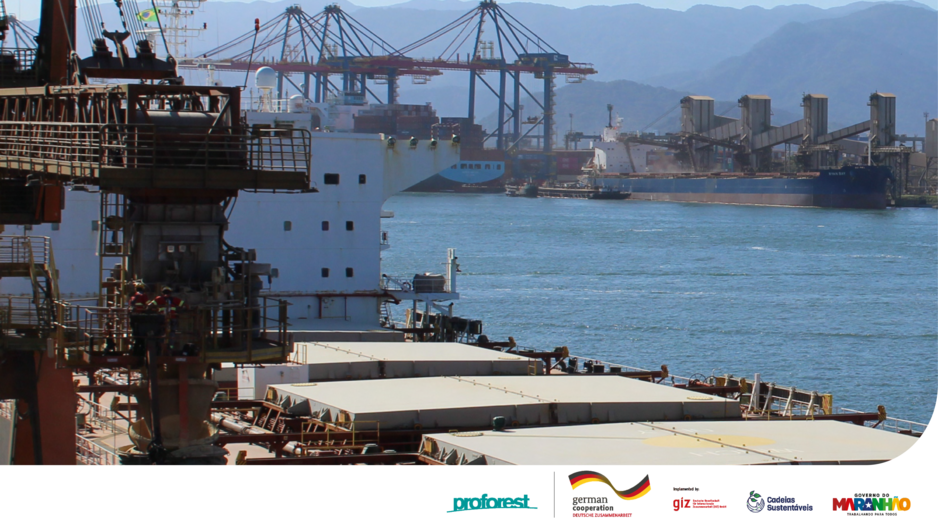
New report estimates logistics-related greenhouse gas emissions from one Brazilian soy trader might increase as an unforeseen consequence of EUDR compliance. While this does not reduce the potential impacts of land use emissions, it highlights important challenges in designing traceability systems that are both effective and climate-efficient.
The EU Deforestation Regulation (EUDR) aims to prevent deforestation by requiring geolocation data, full traceability and documented compliance for specific agricultural commodities entering Europe. A new case study from Proforest, conducted in partnership with RMR Consulting and supported by GIZ, shows that segregating supply lines may unintentionally lead to increased transport emissions in soy production in Brazil.
The traceability challenge
Brazil's soy supply chain was built for efficiency. Over decades, logistics infrastructure - from road and rail networks to river barges and port terminals - was optimised to move large volumes of soy at minimum cost by enabling the blending of product from multiple producers and regions. This has not just allowed Brazil to support its own high levels of domestic consumption for soy but also to become a major exporter to global markets including China and Europe.
The EUDR makes new demands of this model by requiring segregation of compliant and non-compliant volumes. In other words, EUDR-compliant soy must not be mixed with volumes that cannot demonstrate compliance. As a result, soy meal shipments need to be physically segregated throughout the supply chain from farm to port. For traders accustomed to highly integrated, co-mingled logistics systems, this creates a challenge with significant operational implications.
Calculating the carbon costs of commodity segregation
The EUDR's requirement on deforestation-free production is not the primary operational barrier for most traders. Due to only a small volume of soy in Brazil not being free of deforestation, it is already viable to provide deforestation-free soy. However, due to the high burden of proof and related traceability and transparency requirements in the EUDR, producers that are compliant in practice will still struggle to provide the right data and paperwork against all stipulations of the legislation. The other challenge lies in the physical segregation these requirements necessitate.
To better understand the impact of segregating volumes, we modelled three key export corridors from Brazil to the EU, based on the real-life scenario of a trader: via the port of Rio Grande in Rio Grande do Sul; the port of Santos in São Paulo; and via the port of Santarém in Pará, sourcing from Mato Grosso. Neither the Rio Grande nor the Santos routes are currently equipped to deliver fully segregated, EUDR-compliant soy. In Rio Grande there is a high prevalence of smallholder farmers selling through intermediaries and cooperatives, making farm-level origin data difficult to obtain. In Santos, significant mixing occurs between traders at the railway terminal and within the port itself - a problem that cannot easily be solved without major infrastructure modifications or inter-trader collaboration.
The Santarém corridor offers a more viable path to compliance. The predominance of large-scale farms in Mato Grosso makes traceability considerably more tractable, and the processing facility already has dedicated intake lines and segregated storage that can support compliant batching. Our analysis concludes that, under current conditions, the trader would likely shift 100% of EU-bound soybean meal to the Santarém route to ensure cost-effective EUDR compliance.
A Life Cycle Assessment showed that under a fully segregated, EUDR-compliant scenario logistics-related GHG emissions would be approximately 48% higher than under business-as-usual conditions. This is because of the increased distances and higher carbon transportation modes resulting from using road transport instead of rail and waterways. This indicates an unintended trade-off established by regulation - between the ambition to reduce environmental damage, and the reality of increased emissions resulting from transporting segregated volumes.
Implications for industry
Although this study is based on a single trader, and more research is needed, the findings are likely to be representative of the sector. Few traders currently operate fully segregated, EUDR-compliant supply chains, and the operational, financial and carbon costs of transition will be significant across the industry.
For companies and brands sourcing Brazilian soy, this analysis underscores the need to engage proactively with supply chain partners on compliance pathways - and to account for logistics emissions when assessing the overall environmental footprint of EUDR compliance.
For policymakers, the findings highlight that traceability requirements may push supply chains toward less efficient, higher-emission transport routes in some contexts. They also point towards a need to rethink what level of traceability is actually useful for driving action on deforestation in commodity markets and represents an effective allocation of resources.
Proforest supports the EUDR’s goals of reducing deforestation linked to EU consumption and works with individual companies to achieve this, yet this case study indicates that greater infrastructure investment and collaboration between traders may be needed to overcome unforeseen logistical emissions. Local consequences of compliance in producer countries like this also need to be communicated downstream to better inform the decision-making process of policy makers and buying decisions of major operators in consumer countries.
Read the full report: Logistics-Driven GHG Impacts in EUDR-Compliant Soy Supply Chains - A Case Study in Brazil (Proforest & RMR Consulting, May 2026, supported by GIZ).
Related articles


Kategori: Iklim Amerika Latin Kedelai