29 Oktober 2026
Sustainable Landscapes Partnership (SLP) advances co-investment agenda to scale up sustainable landscapes in the Cerrado at Climate Week NYC

The session brought together companies, financial institutions and implementing organisations to discuss how to finance the agricultural transition, share risks and strengthen supply chain resilience.
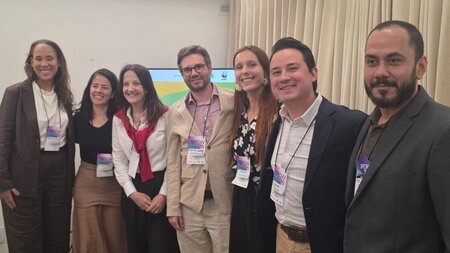
Scaling up landscape initiatives requires connecting local experience with financing mechanisms that can sustain long-term transformation. This was the focus of the Sustainable Landscapes Partnership (SLP) Co-Investment Working Session, held on 22 September during Climate Week NYC 2026 in New York.
Convened by the World Business Council for Sustainable Development’s (WBCSD) Soft Commodities Forum (SCF), IFACC and The Consumer Goods Forum’s (CGF) Forest Positive Coalition (FPC), with support from Proforest, the session brought together 24 representatives from supply chain companies, financial institutions and civil society organisations. The participation of banks and financial institutions broadened the discussion on how to structure investments to support the agricultural transition across production landscapes.
With support from Proforest, the SLP brings together commodity traders and major buyers to advance sustainable and resilient landscapes in the Cerrado. Its approach combines incentives for producers, ecosystem conservation and collaboration among stakeholders, contributing to deforestation- and conversion-free supply chains.
From local experience to increased investment
The session featured two of the four landscape initiatives supported by the SLP in the Cerrado. Drawing on the partnership’s progress and experience from the Consórcio Oeste de Mato Grosso and Paisagens Sustentáveis Tocantins initiatives, participants explored opportunities for scaling up with potential funders.
Proforest is a partner in the Western Mato Grosso initiative, working alongside Instituto PCI, IPAM and Produzindo Certo to connect private sector commitments with local capacities and needs. This experience helps translate corporate ambitions into coordinated action across the landscape and provides lessons to inform the partnership’s development.
One of the challenges discussed was the shift from grant funding towards structures capable of mobilising larger volumes of capital for the projects supported by the partnership. In this context, blended finance, which combines public, philanthropic and private funding, was identified as a way to share risks and enable participation by different investors.
Resilience as a driver of investment
The session highlighted supply chain resilience as a central motivation for corporate investment in landscapes. Severe droughts, for example, can affect agricultural productivity and river transport, with direct consequences for supply and business operations.
By connecting the transition to sustainable agriculture with the management of these risks, the landscape approach strengthens the relationship between conservation, production and business continuity. Companies’ own financial contributions were also discussed as a way to share risks and create conditions to attract additional funders.
Another key point was the recognition that different interventions require different funding sources. Activities with the potential to generate financial returns may attract commercial capital, while essential activities, such as strengthening landscape governance, securing land tenure and providing some forms of technical assistance, continue to require grants or philanthropic funding. Bringing these funding needs together is essential to financing landscape transformation in an integrated way.
Producers at the heart of solutions
The transition also depends on conditions that work for producers. Participants highlighted that producers take on immediate operational risks when adopting new practices and need incentives that reflect this challenge.
Options discussed included combining lower-interest credit, technical assistance, payments for ecosystem services and incentives linked to carbon and traceability. Bringing these instruments together can support the adoption of sustainable practices and diversify farm income streams.
Collaboration to achieve scale
The session reinforced the value of joint action by traders, buying companies, funders and implementing organisations. By sharing risks and coordinating investments within the same landscape, these stakeholders can support complementary interventions and address challenges that extend beyond any single supply chain.
For Proforest, this connection between global ambition and local action is central to advancing the SLP. The approaches discussed in New York reinforce the partnership’s potential to mobilise additional funding and scale up a transition that strengthens agricultural production, conserves ecosystems and delivers lasting benefits for people, nature and climate in the Cerrado.
🔗Download the Sustainable Landscape Partnership Vision here
*Image by Brazil Regenerative Landscapes
Kategori: IklimProduction Landscape ProgrammesResponsible FinanceInisiatif lanskapAmerika Latin