30 septiembre 2026
Proforest contributes to Revista P de Palma with an article on NDPE IRF 6.0
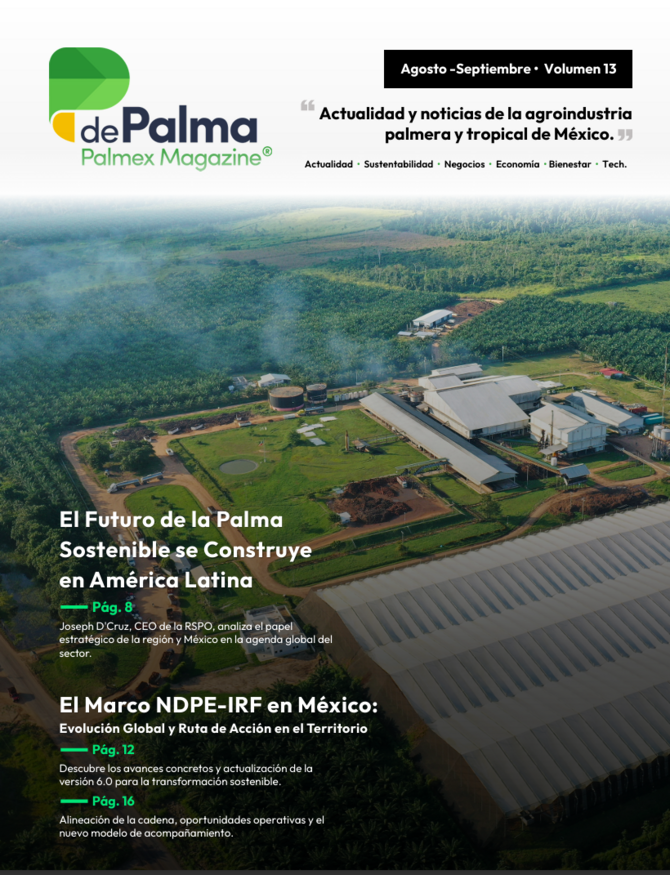
Daniel Arancibia, Director of Proforest Northern Latin America, contributed to the latest edition of Revista P de Palma, a publication by FEMEXPALMA focused on Mexico's palm oil sector, with an article on the update to version 6.0 of the NDPE Implementation Reporting Framework (IRF) — the reporting framework that measures progress in implementing No Deforestation, No Peat Expansion and No Exploitation (NDPE) commitments across oil palm supply chains.
The article addresses a central issue for the sector: the difference between adopting sustainability commitments and being able to demonstrate, with evidence, how they are implemented and what results they generate.
From commitments to implementation
The article explains that, since 2019, companies in the sector have adopted NDPE policies to cover and understand their supply base, whether certified or not, without this approach replacing voluntary or mandatory certification processes. The NDPE IRF was created precisely to help make sense of the complexity of these supply chains and demonstrate progress, functioning as a progressive reporting tool that allows systematic assessment of progress in implementing NDPE commitments.
Proforest was a founding technical partner of the methodology, developed collaboratively with companies from different links in the chain that form part of the Palm Oil Collaboration Group (POCG), a private-sector platform created to accelerate effective implementation of NDPE commitments.
A common language, without a "pass or fail" logic
One of the contributions highlighted in the article is that the NDPE IRF avoids a binary compliance logic. Instead, it uses progress categories that make it possible to identify which actions are already under way, where gaps remain, and what steps are needed to advance — turning broad commitments into a more concrete, actionable roadmap for extraction plants as well as refineries, traders and consumer brands.
The 6.0 update and its relevance for the region
Version 6.0, published in January 2026, is the version that must be used to report volumes traded in 2025. Among its main updates, it incorporates traceability to the production area as a scoring element and reinforces the idea that a responsible chain cannot assess environmental and social impacts separately.
For Mexico and Latin America, the article argues that this tool represents a clear opportunity: to demonstrate, with evidence, that the palm sector respects land, communities and nature.
Continuous improvement, not exclusion
The article closes with a message relevant to managing supply chains that include smallholders: the logic of continuous improvement and risk management requires avoiding a response to gaps that simply abandons producers or territories. Transforming supply chains requires engagement, capacity building and sustained collective action, particularly in productive landscapes where smallholders are involved or where challenges exceed what a single company can resolve.
You can read Daniel Arancibia's full article on pages 12 and 13 of Revista P de Palma, available at the following link: Revista P de Palma.